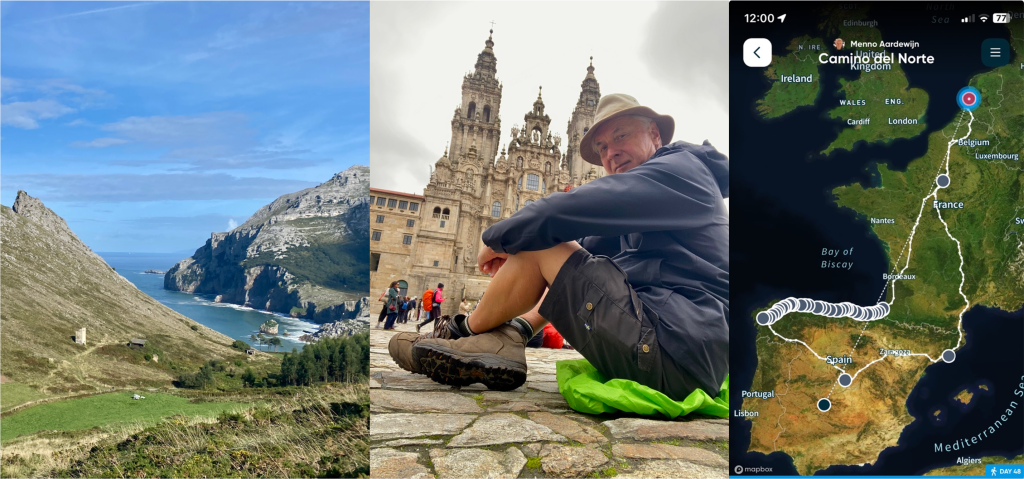
On September 17, 2024, I took the train from Haarlem to Biarritz, on my way to Irun at the border of France and Spain, where I started the Camino del Norte two days later. This 830 km walking path runs along the northern coast of Spain towards Santiago de Compostela, where I arrived healthy and well on October 25, after 37 days of walking. Two days later, I took the train to Madrid to admire Picasso’s Guernica in the Reina Sofia, then to Barcelona to see the interior of Gaudí’s Sagrada Familia and to visit a digital exhibition of the Spanish painter Joaquín Sorolla, and finally to Paris to see the reconstruction of the Notre Dame, some abstract art in Centre Pompidou, and the Impressionists painters in the Orsay Museum. On November 3, I slept wonderfully in my own bed in Haarlem again. In total, I was on the road for 46 days without blisters, injuries, problems or incidents of any kind and lightness in my heart all the time.
I am grateful to life for being in the circumstances that allow me to undertake these kind of journeys now. 10 years ago I couldn’t imagine this. When however certain doors in life unexpectedly close, no matter how sad, other doors apparently open. And if you’re able to move fluidly with the changes that come your way and accept it, a new world opens up; one that even holds enough space for the beautiful things, memories and love from the past that you don’t want to lose. In this way, you can move forward freely, without resentment toward an even richer life. And that’s my story walking the Camino del Norte.
Walking the Camino is a unique experience. Every step is an adventure in the open space of life where new “things”’ pass your way. You primarily encounter yourself: the signals from your body, your emotions, and the many thoughts spinning in your mind. After a while, the rhythm of walking seems to bring a certain order to it all, unconsciously calming your inner self and sharpening your awareness of your surroundings, grounding you in the here and now. This created space for me to appreciate nature and observe birds. I ended up spotting 84 bird species, including a few I had never seen before: the griffon vulture and the cattle egret. I also experienced the beauty of the rugged coastal landscape, gathering impressions for my watercolors in my memory. Additionally, I became more aware of the distinctiveness of Spanish culture: the sound of the language, the lifestyle of the locals, the architecture, and the Spanish customs, specialties, and delicacies. And finally I can mention the people you meet on your path; people from all over the world who, for whatever reason, want to walk the Camino. That gives a great opportunity to listen to their sometimes surprising thoughts and feelings about the world, love and life. That’s the beauty of being on the road.
I love walking, for that wonderful slowness that gives you time to truly look at the world, and because everything is reduced to the essentials: where will I sleep, and what will I eat? With fleeting, often personal encounters with people from all over, where politics and religion don’t yet matter, where it is not about demands but about accepting what is. In the simplicity of existence, far away from the complexities that so often define human life, I am immersed in the morning’s silence, breathing in the beauty of nature, and finding peace in small churches or in the woods. My body keeps on walking, and I simply follow, feeling good in my skin, enjoying whatever comes my way, and being surprised by the kindness I receive.
For me, the Camino del Norte is not just a physical path; I also see a mental sphere that surrounds the physical trail like a long aura. From the moment you begin the Camino, you step into this atmosphere, and upon reaching the endpoint, you step out of it again. This atmosphere is created not only by the pilgrims and hikers but also by the local people who know the trail, maintain it (signage), provide food (shops, restaurants, bars, cafés), offer places to sleep (albergues, hotels), and, if desired, stamp your pilgrim’s passport. All of this creates a walking route that offers a sense of familiarity, trust, and safety, where pilgrims can meet one another as equals (with no regard for status) and as fellow travelers taking on the same challenge. And because they will likely only meet briefly and just once, there seems to be little inhibition in openly sharing their experiences on the trail and their life stories—something that rarely happens in ordinary life. It all unfolds in a way as if in a different, simpler dimension of existence. It’s like an accelerated life, where only the essential things play a role and people come and go as in real life, but much quicker; years become hours.
I deliberately chose the Camino del Norte because it hasn’t yet become as crowded as the Camino Francés, especially in the period from late September to November. Each day, I encountered only a few people and mostly walked entirely alone, which I find wonderful. Only the final stretch, where many Camino routes converge on the way to Santiago, felt like walking through a busy shopping street—but that was just the last day. The reason the Camino del Norte has far fewer hikers is likely due to its difficulty. The stages are long and often extremely challenging, with endless climbs and descents on trails that can hardly be called paths, with in my case eleven kilos on my back. However, the beauty of the landscape and the breathtaking views make it all worthwhile.
They say that if you meet someone three times on the Camino—a rare occurrence—that person can be considered part of your Camino family. It truly feels that way; it brings such joy to unexpectedly see someone again with whom you had a lovely half-hour conversation weeks before, especially if it’s for the third time. My journey was enriched by several Camino family members whose openness, honesty, kindness, insights, and ideas shaped my experience. These were Maarten (NL), Jos (NL), Kinschy (JP), Michael & Yvonne (UK, perhaps we meet one day in Canterbury), Troy & Cindy (Texas, US, and their great book recommendation: The Body Keeps the Score), Kim & Anne (Copenhagen, DK), Jim (Michigan, US—the only pilgrim I met again in Santiago de Compostela), and my number one Camino family member (the angel) Elona from Lithuania.
There’s a saying that the Camino doesn’t give you what you wish for, but rather what you need. This brings me to the question: why did I actually walk the Camino? I can only think of a deep desire to spend an extended period away from home, on my own, in an environment entirely new to me, to see if I would feel at home and at ease there as well. It was both a wish and an experience I needed, as it reveals something about where I am in life and how I now relate to the universe. On the final day, as I attended the ‘mandatory’ pilgrim mass in the cathedral at Santiago de Compostela, and to my delight witnessed the spectacular Botafumeiro incense ritual, I felt that I had done everything I set out to do, had felt at home everywhere and that my Camino had been a success. I officially dedicated my Camino to my children Hebe and Roeland for their love, support, and enthusiasm over the years, and I secretly hope that I’ve inspired them to embark on a similar journey someday in the future.
 OBSERVATIONS